

SUP9 vs SUP9A: both are chromium-manganese spring steels under JIS G 4801, and the difference is small but decisive. SUP9A carries slightly more carbon, manganese and chromium, so it hardens through thicker sections. In the American designation system, SUP9A is the same steel as AISI 5160.
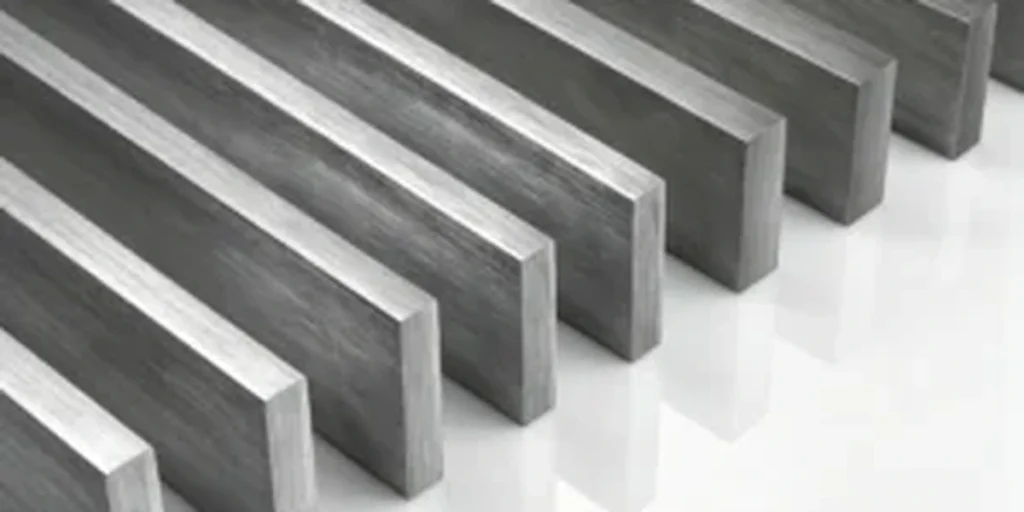
SUP9 vs SUP9A: What Is the Difference?
The difference is in the composition. Under JIS G 4801, the two grades share the same silicon, phosphorus, sulfur and copper limits; only carbon, manganese and chromium move:
- Carbon: SUP9 0.52–0.60% vs SUP9A 0.56–0.64%
- Manganese: SUP9 0.65–0.95% vs SUP9A 0.70–1.00%
- Chromium: SUP9 0.65–0.95% vs SUP9A 0.70–1.00%
- Silicon 0.15–0.35%, phosphorus and sulfur each ≤0.030%, copper ≤0.30%: identical
Those extra points of carbon and chromium do one thing: they raise hardenability. When a thick spring is quenched, the surface cools fast but the core cools slowly. SUP9A’s chemistry lets the core reach the same hardness as the surface, so a thick leaf does not come out soft in the middle. The trade-off is cost and a slightly harder material to process.
The practical result: higher carbon raises the maximum attainable hardness, and more chromium slows the transformation during cooling. Together they allow a thicker section to reach full hardness in the core. The SteelStandart 5160 datasheet describes genuine through-hardening in a 25 mm leaf; SUP9 is usually selected for thinner sections where that hardening depth is not needed.
Naming can confuse buyers. SUP9A is the JIS name; the American designation for the same steel is AISI 5160 (UNS G51600). So a search for “SUP9 vs 5160” is asking the same question as “SUP9 vs SUP9A” — one comparison, two naming systems.
In one line: SUP9 and SUP9A differ in hardenability, and hardenability decides how thick a spring section you can safely make.
SUP9: The Standard Leaf Spring Grade
SUP9 is the most common alloy spring steel for leaf springs and stabilizer bars in the JIS system. Its composition under JIS G 4801 is carbon 0.52–0.60%, silicon 0.15–0.35%, manganese 0.65–0.95%, chromium 0.65–0.95%, with phosphorus, sulfur and copper each limited to 0.030% or 0.30%. On international drawings, the same steel appears under different names: SAE/AISI 5155 in the US, DIN 55Cr3 (EN 10089) in Europe and GB 55CrMnA in China. These are equivalent designations of the same grade, not separate steels.
After oil quenching at 830–860 °C and tempering at 460–510 °C, reference mechanical properties are a tensile strength of at least 1230 MPa, a 0.2% proof stress of at least 1080 MPa, an elongation of at least 9%, and a hardness of 363–429 HBW. These are reference values after standard heat treatment, not guarantees for as-rolled bar.
In the workshop, SUP9 is the default for a reason. It heat-treats predictably, its fatigue strength suits road and off-road springs, and it costs less per tonne than SUP9A. For leaf packs up to medium thickness, the extra hardenability of SUP9A simply is not needed.
Typical applications follow the same pattern: passenger and light-truck leaf springs, stabilizer bars, agricultural spring parts and machine springs all run on SUP9 when the section stays moderate. The bar also punches and forms well in the as-rolled state, which keeps fabrication cost low for spring makers who cut, punch and heat treat in-house.
The limit shows up as thickness grows. The core of a very thick SUP9 leaf may not fully harden, which lowers the fatigue life of the part. That is the exact case SUP9A was created for.
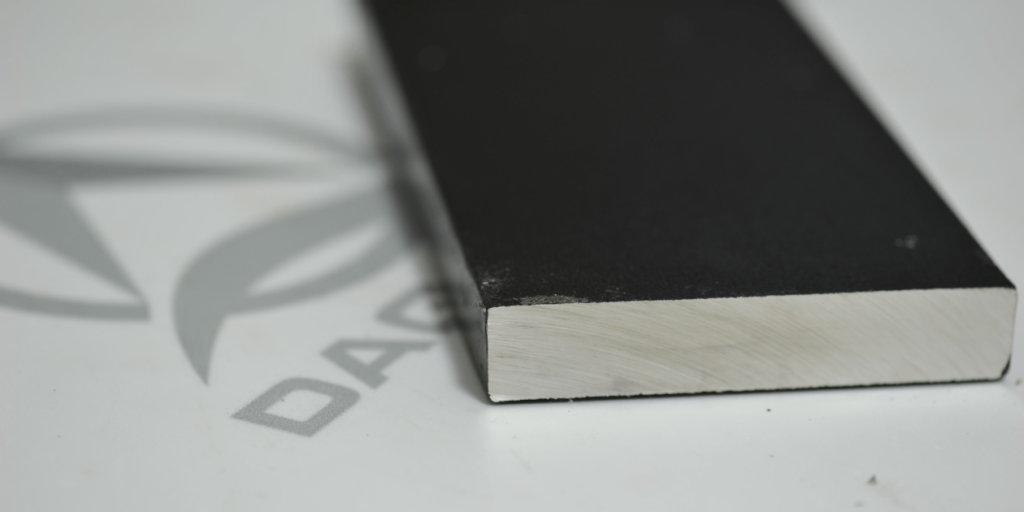
SUP9A (AISI 5160): The Thicker-Section Upgrade
SUP9A under JIS G 4801 is carbon 0.56–0.64%, silicon 0.15–0.35%, manganese 0.70–1.00%, chromium 0.70–1.00%, with phosphorus, sulfur and copper limits identical to SUP9. In the American system the same analysis is AISI 5160, specified in ASTM A29 and SAE J404 (UNS G51600).
This is why SUP9 vs 5160 is the same comparison as SUP9 vs SUP9A: 5160 is the SAE name of the JIS grade. A North American drawing calling for 5160, and a Japanese drawing calling for SUP9A, are asking for the same steel. Knowing that the names map to one chemistry saves quoting errors and delays.
Heat treatment behaves the same way, with one difference: SUP9A comes out of the oil harder. As-quenched hardness is typically 60–63 HRC, which is above what any spring needs, so the tempering temperature sets the final result — roughly 50–53 HRC after tempering at 425 °C, 45–49 HRC after 480–500 °C, and 38–42 HRC after 540 °C. Leaf springs are normally finished at 44–48 HRC. In practice, most “5160 failures” are under-tempered parts or decarburized surfaces, not a weakness of the steel.
Use SUP9A where the section is thick and the load is heavy: heavy-duty truck leaf packs, stabilizer bars with large cross-sections, and springs that must hold their set under repeated impact. The extra carbon and chromium buy through-hardening, and through-hardening buys fatigue life.
Outside the spring industry, 5160 has a second life as a forging and blade steel. Knife and tool makers choose it for the same reason spring makers do: it is tough, cheap, forges easily and hardens without expensive alloys. Agricultural tines, plough points and hand tools are common users of the same flat bar stock. If your part is not a spring at all, the 5160 analysis is still worth quoting against cheaper carbon steels.
Side-by-Side Comparison
The SUP9 vs SUP9A comparison is summarized in the table below. Values are reference figures after standard heat treatment, not guarantees for a specific heat.
|
Grade |
Standard |
Carbon |
Manganese |
Chromium |
Heat Treatment Reference |
Typical Uses |
|
SUP9 |
JIS G 4801 |
0.52–0.60% |
0.65–0.95% |
0.65–0.95% |
Tensile ≥1230 MPa; 363–429 HBW |
Leaf springs, stabilizer bars, medium sections |
|
SUP9A |
JIS G 4801 / AISI 5160 |
0.56–0.64% |
0.70–1.00% |
0.70–1.00% |
As-quenched 60–63 HRC; leaf temper 44–48 HRC |
Heavy-duty leaf springs, thick sections |
Read the heat treatment column carefully: SUP9’s tensile figure is a reference for the oil-quenched and tempered condition, while SUP9A’s numbers describe the hardness band you target by tempering. A spring buyer who quotes a tensile strength should give the mill both the grade and the required heat treatment condition.
How to Choose: SUP9 or SUP9A?
When you weigh SUP9 vs SUP9A for a new drawing, start with the section thickness. Thin and medium spring sections harden fully in SUP9, so the extra alloy buys nothing. As the section grows, the hardenability gap widens, and SUP9A becomes the reliable option.
Second, look at the load. Standard leaf packs and stabilizer bars on light and medium vehicles run well on SUP9. Heavy-duty suspension, repeated impact and high load cycles justify SUP9A even in medium thickness, because fatigue life depends on core hardness.
Third, check your own heat treatment. Both grades are oil quenched and tempered; the difference is only the target hardness band and the tempering window you hold. If your line already tempers leaf springs at 44–48 HRC, SUP9A drops into the same process.
Fourth, compare cost and supply. SUP9 is more widely stocked and a little cheaper per tonne; SUP9A is the safer choice for thick or heavy parts, where rework and field failures cost far more than the alloy premium. When in doubt, send the drawing thickness and the target hardness — most mills, including ours, will confirm the grade for free.
One common misconception: SUP9A is not automatically better than SUP9. In thin sections the two perform almost identically, and SUP9 costs less. Specifying SUP9A where the part is a thin helper leaf buys alloy you do not use. The opposite mistake is more dangerous: using SUP9 for a thick heavy-duty leaf and blaming the mill when the core softens. Match the grade to the section, and both steels perform.
Whichever you choose, buy the spring steel flat bar from a supplier that can hold tolerances and issue a mill certificate, because the grade is only half of the story.
Sourcing Spring Steel Flat Bar in Bulk
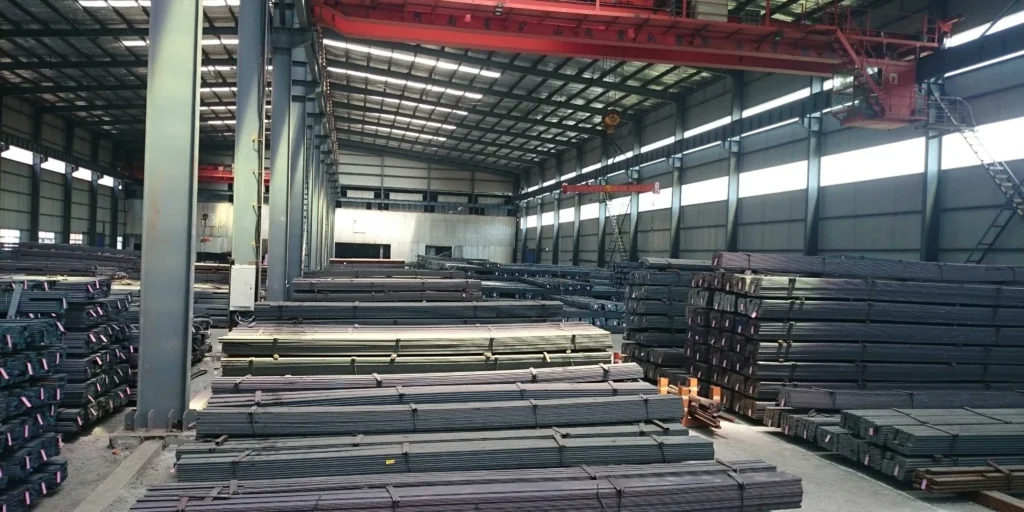
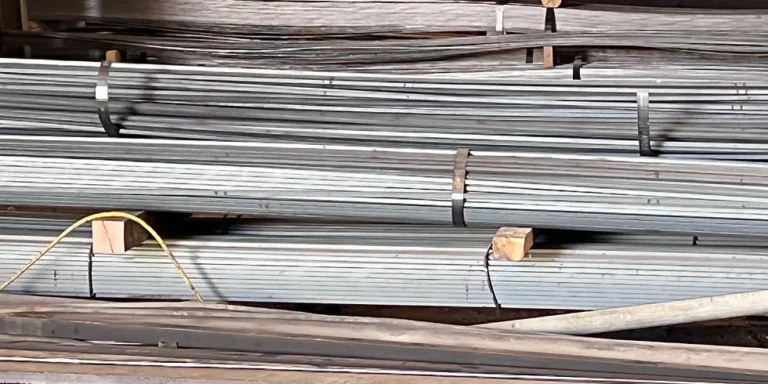
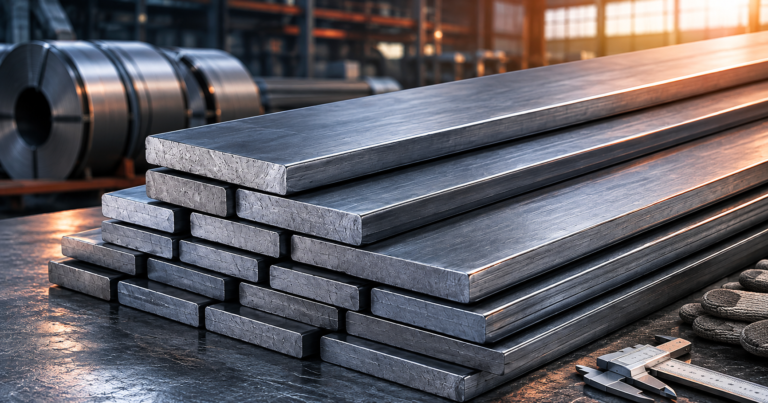
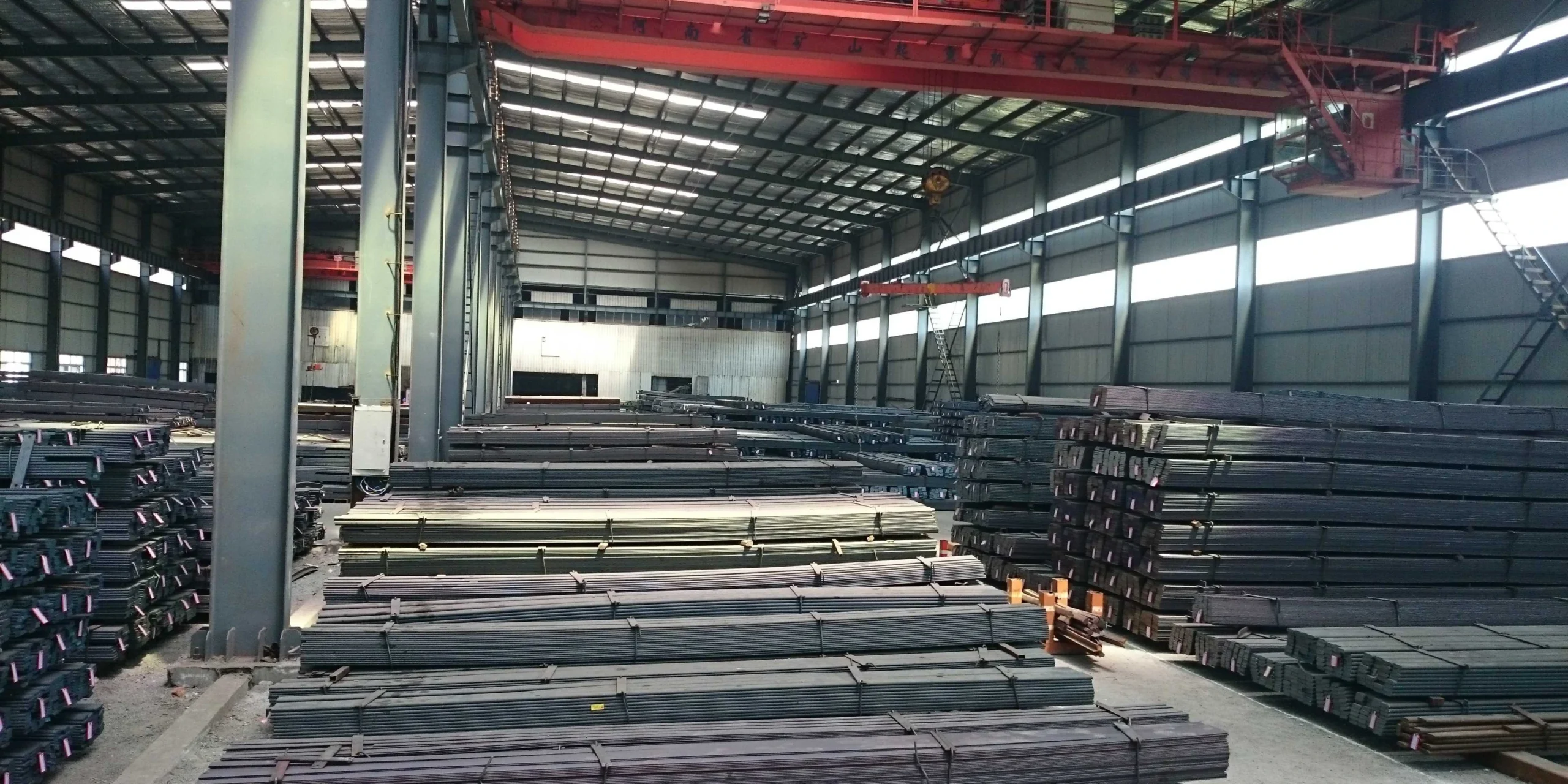
We supply hot-rolled spring steel flat bar in widths of 38–150 mm (1.5–5.9 in) and thicknesses of 4–35 mm (0.16–1.38 in), cut to length per your drawing. Tolerances are held to ASTM, GB, JIS, DIN and BS standards, and surface options include black, pickled and coated finishes.
The product range covers carbon spring steel 65Mn, silicon-manganese grades 60Si2Mn and 60Si2MnA, chromium grades 55Cr3, 55CrMnA and 60CrMnA, the JIS G 4801 series — SUP6/9260, SUP9/5155, SUP9A/5160, SUP10A/6150, SUP11/51B60 — and vanadium steel 50CrV4. Custom grades and dimensions are available on request.
Quality control is built into the delivery: production lots pass through physical and chemical testing laboratories before release, and every shipment carries a mill certificate.
To get an accurate quote, send four numbers: width, thickness, length or coil weight, and quantity — plus the grade, the surface finish and the target hardness if the drawing specifies them. With those inputs we confirm the rolling program, the tolerance standard and the delivery time, and issue the mill certificate with the shipment.
FAQ
Q1. Is SUP9A the same steel as 5160?
Yes. SUP9A is the JIS G 4801 name and 5160 is the SAE/ASTM name of the same analysis. Drawing numbers may use either designation; the composition limits match within normal tolerances.
Q2. Which is better, SUP9 vs SUP9A?
There is no absolute winner. SUP9 is the cost-effective standard choice for thin and medium sections; SUP9A hardens through thicker sections and lasts longer under heavy loads. Match the grade to the thickness and the stress.
Q3. Can SUP9 vs SUP9A be used interchangeably?
For thin sections, usually yes. For thick sections, no: SUP9 may not fully harden in the core, which shortens fatigue life. If the drawing specifies one grade, follow it.
Q4. What is the minimum order for spring steel flat bar?
The MOQ is 25 tons and annual production capacity is 400,000 tons. Custom dimensions, surface finishes and grades are available, and a mill certificate is provided with every shipment.
Q5. Do you supply both SUP9 and SUP9A flat bar?
Yes. Both grades are part of our standard spring steel flat bar program, together with the other JIS G 4801 grades, and custom compositions can be produced on request.
Q6. What is 5160H, and how is it different from 5160?
5160H is the same analysis ordered to a guaranteed hardenability band under ASTM A304, with a slightly widened carbon range of 0.55–0.65%. Spring makers with a fixed quench buy 5160H so that hardness repeats from heat to heat. If your process depends on consistent response, ask for the H version.
Q7. Can SUP9A be supplied as hot-rolled flat bar for in-house heat treatment?
Yes. Both SUP9 and SUP9A are supplied in the hot-rolled condition for customers who quench and temper in their own plant, and as oil heat-treated bar where the mill performs the treatment. State the required delivery condition when you order.
Request a Quote
Not sure whether your drawing needs SUP9 or SUP9A? Send us the section thickness, the load or stress data and the target hardness. Our technical team will confirm the grade, the heat treatment and the dimensions, and quote bulk pricing for your volume. Contact us — we reply with a specification sheet, not just a price.